
Aircraft Carburetor Basics: How They Work, Types, Maintenance, and Overhaul
May 30th, 2026Posted by Cristhian Vera
An aircraft carburetor is a mechanical fuel metering device that uses pressure differences created by airflow through a venturi to draw fuel into the engine’s intake air. This allows fuel delivery to scale proportionally with airflow demand without requiring electronic controls or pressurized fuel distribution.
While mechanically simpler than fuel injection systems, carburetors depend on clean internal passages, accurate calibration, and proper mixture control to maintain consistent operation. Common issues such as rough idle, hesitation, or inconsistent fuel flow are typically the result of wear, contamination, or metering drift rather than a single component failure. Understanding how these systems work and what causes them to degrade helps pilots and mechanics make better-informed maintenance and overhaul decisions.
What Is an Aircraft Carburetor?
An aircraft carburetor is a mechanical device that introduces metered fuel into the intake airflow to create a combustible air-fuel mixture for piston engine operation. It works by routing intake air through a venturi, a narrowed section of the induction path, where the air accelerates and creates a localized drop in pressure. This pressure differential draws fuel from a float chamber through calibrated jets and into the airstream, producing the air-fuel mixture delivered to the cylinders.
Because fuel delivery is governed by pressure relationships and airflow rather than by electronic sensors or pressurized fuel lines, the carburetor is a relatively simple and self-contained metering system. However, this also means that metering accuracy is sensitive to internal wear, contamination, and changes in operating conditions such as altitude and temperature.
How Does an Aircraft Carburetor Work?
As air enters the carburetor and passes through the venturi, it accelerates and creates a pressure drop relative to the surrounding atmosphere. This pressure differential draws fuel from the float chamber through calibrated metering jets and into the intake airstream, where it mixes with incoming air before reaching the cylinders.
Throttle position controls how much air flows through the carburetor, which directly influences how much fuel is drawn into the mixture. The mixture control allows the pilot to adjust fuel flow relative to changing air density, which is particularly important during climb and cruise at altitude where thinner air would otherwise cause the engine to run excessively rich.
Fuel metering in a carburetor is entirely governed by airflow dynamics and internal pressure relationships. There is no direct measurement of engine speed, fuel pressure, or fuel demand. This makes accurate internal calibration and clean fuel passages essential to consistent performance.
What Are the Different Types of Aircraft Carburetors?
Float-Type Carburetors
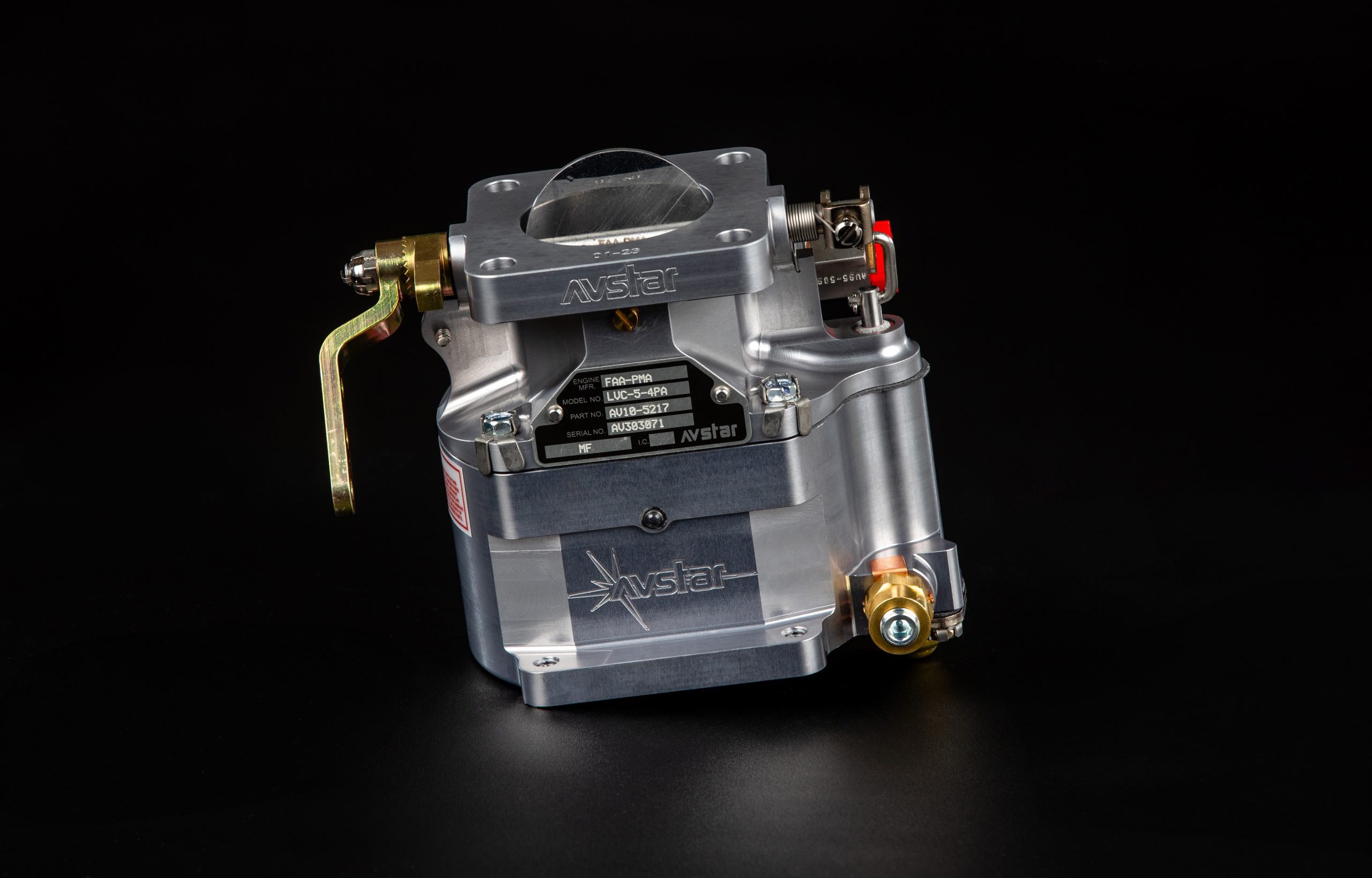
Float-type carburetors are the most common type used in general aviation piston engines. They use a float chamber to maintain a consistent fuel level and rely on gravity and venturi-driven pressure differentials to meter fuel into the airstream. Models such as the LVC-5-4PA and LVC-3-3PA are widely used on Lycoming-powered aircraft.
Float-type carburetors are mechanically simple and well-proven, but they can be sensitive to carburetor icing during certain temperature and humidity conditions, changes in aircraft attitude that affect fuel level in the float bowl, and fuel contamination that can restrict metering jets or passages.
Pressure Carburetors
Pressure carburetors eliminate the float bowl entirely and instead use a servo-regulated fuel metering system based on airflow and impact pressure. This design allows the carburetor to maintain more consistent fuel delivery across a wider range of operating conditions, including varying aircraft attitudes and higher power settings. The trade-off is additional system complexity and more involved calibration requirements during maintenance and overhaul.
What Components Wear Out in an Aircraft Carburetor?
The key components inside an aircraft carburetor include the float and needle valve assembly, metering jets and internal fuel passages, throttle and mixture control shafts, and the throttle body bore. Over time, these components experience wear that affects clearances, contamination that restricts fuel flow, and corrosion that alters metering characteristics. Even small changes in internal passage geometry can affect idle quality, mixture distribution, and overall engine smoothness. AVStar manufactures replacement carburetor components from CNC-machined 6061-T6 billet aluminum to improve dimensional consistency and corrosion resistance compared to legacy cast parts.
When Should You Overhaul an Aircraft Carburetor?
Carburetor overhaul timing depends on operating conditions, fuel quality, and observed engine performance. The most common indicators that a carburetor needs overhaul include rough or unstable idle, hesitation during throttle application, inconsistent fuel flow, and difficulty maintaining proper mixture. These symptoms typically signal that internal fuel metering has drifted outside its intended calibration. For AVStar carburetors specifically, Service Bulletin AFS-SB7 provides guidance on inspection and overhaul intervals and should be followed alongside engine manufacturer recommendations.
What Does an Aircraft Carburetor Overhaul Include?
A standard aircraft carburetor overhaul includes complete disassembly of the unit, detailed inspection of all wear components, thorough cleaning of internal passages and metering jets, replacement of seals and any parts that fall outside serviceable limits, and reassembly with calibration to manufacturer specifications. All work must be performed in accordance with approved maintenance data to ensure the carburetor meets its required operating characteristics before returning to service.
AVStar offers both exchange and outright carburetor programs for owners and shops that need a ready-to-install unit while their existing carburetor is overhauled or evaluated.
How Does a Carburetor Compare to Fuel Injection in Aircraft?
Carburetors meter fuel based on airflow and venturi-driven pressure differentials, while fuel injection systems deliver fuel under pressure and meter it more directly using airflow and system signals. Fuel injection can provide more consistent cylinder-to-cylinder fuel distribution and more precise mixture control at altitude, but it also introduces greater system complexity, sensitivity to fuel contamination, and hot-start considerations.
Carburetors remain widely used in general aviation because of their mechanical simplicity, lower maintenance complexity, and proven reliability when properly serviced. Neither system is universally superior. Each has distinct strengths and trade-offs depending on the aircraft, engine type, and operating environment. For a more detailed comparison, see our guide on aircraft fuel injection system behavior.
What Are the Best Maintenance Practices for Aircraft Carburetors?
Effective carburetor maintenance starts with regular fuel sump draining to reduce contamination risk, consistent monitoring of engine performance trends during ground runs and flight, and prompt investigation of early signs of roughness, hesitation, or fuel flow irregularity. Tracking changes in idle quality, throttle response, and mixture behavior over time helps identify developing wear or contamination issues before they affect safe operation.
AVStar publishes service bulletins and technical documentation for all current carburetor models. Operators and maintenance shops should consult these alongside engine manufacturer guidance to ensure inspections and maintenance actions are performed at the correct intervals and to the correct standards.
How Do You Select the Right Aircraft Carburetor?
Carburetor selection should be based on three primary factors: engine compatibility, operating environment, and availability of long-term maintenance support. The carburetor must be approved for the specific engine and airframe combination, and the operator should confirm that replacement parts, overhaul support, and technical documentation are available for the model selected.
Consistency in fuel metering and repeatable calibration are the most important indicators of long-term reliability. Browse AVStar’s carburetor product line to review approved models for Lycoming-powered applications, or contact AVStar for engine eligibility and application guidance.
Bottom Line
Aircraft carburetors remain a widely used and reliable fuel metering solution for general aviation piston engines when properly maintained. Their performance depends on accurate internal calibration, clean fuel delivery, and correct mixture management by the pilot.
Understanding how carburetors function, how they wear over time, and when to overhaul them allows operators and mechanics to keep fuel delivery consistent and engines running smoothly. For airframe-specific guidance, see our Cessna 172 fuel system breakdown, or explore AVStar’s full product catalog for FAA PMA-approved carburetor and fuel injection components.
Frequently Asked Questions
What does an aircraft carburetor do?
An aircraft carburetor meters fuel into the intake airflow to create a combustible air-fuel mixture for piston engine operation. It uses the pressure drop created by airflow through a venturi to draw fuel from a float chamber and into the airstream proportionally to engine demand.
How does a carburetor differ from fuel injection in aircraft?
Carburetors rely on airflow and venturi-driven pressure differentials to draw fuel into the engine, while fuel injection systems meter fuel under pressure and deliver it directly to each cylinder. Fuel injection can provide more consistent cylinder-to-cylinder distribution, but both systems require proper maintenance and calibration to operate reliably.
Why is mixture control important in carbureted aircraft?
Mixture control is essential because air density decreases with altitude. Without adjusting the mixture, a carbureted engine will run progressively richer as the aircraft climbs, reducing power output and increasing fuel consumption. The mixture control allows the pilot to lean the fuel-to-air ratio to maintain efficient combustion as atmospheric conditions change.
What are common signs of carburetor problems?
The most common signs of carburetor problems are rough or unstable idle, hesitation during throttle changes, inconsistent fuel flow, and reduced engine responsiveness. These conditions typically indicate contamination in the metering passages, internal wear affecting component clearances, or calibration drift that has moved fuel metering outside its intended range.
How often should an aircraft carburetor be overhauled?
Overhaul intervals depend on the engine type, operating conditions, and manufacturer recommendations. In practice, carburetors are often overhauled during engine overhaul or earlier when performance issues indicate degraded fuel metering. For AVStar carburetors, Service Bulletin AFS-SB7 outlines specific inspection and overhaul interval guidance.
Can a carburetor cause engine roughness?
Yes. Inconsistent fuel metering caused by restricted passages, worn jets, or air leaks within the carburetor can produce uneven fuel distribution between cylinders, which results in rough engine operation. A properly calibrated carburetor with clean internal passages is essential to smooth, consistent engine performance.
Does overhauling a carburetor improve performance?
An overhaul restores the carburetor to its specified calibration and operating condition by replacing worn parts, cleaning restricted passages, and verifying metering accuracy. This typically improves consistency in fuel delivery, throttle response, and idle quality when wear or contamination had degraded performance.
Are carburetors still used in modern aircraft?
Yes. Carburetors remain widely used across the general aviation fleet due to their mechanical simplicity, proven reliability, and lower maintenance complexity compared to fuel injection. Many current-production and legacy Lycoming-powered aircraft continue to operate with float-type carburetors as their primary fuel metering system.